
What Happens When We Meet an Animal’s Gaze?
June 2026
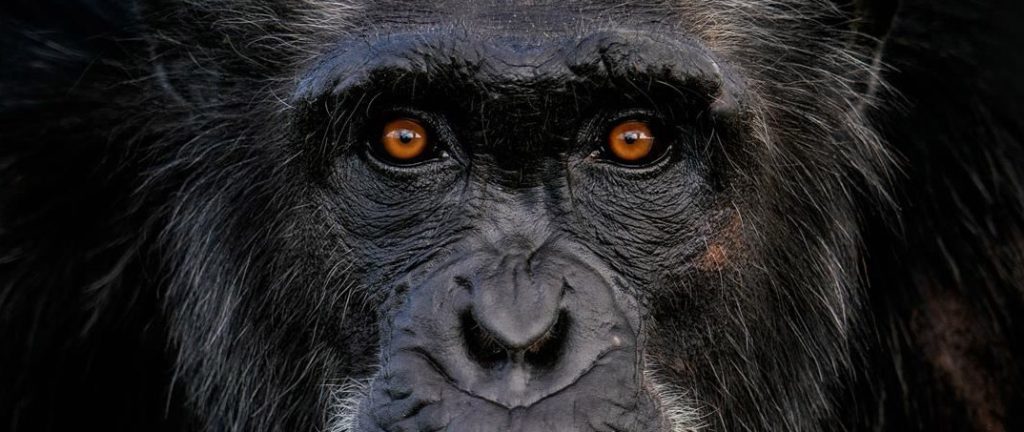
Across from my house, beside a river, there is a colony of wild geese. I have been watching them every day for years. When I go out with food, they run toward me, and I watch them as they eat, thinking the same thing I always think: how do they see me? What is going through their minds? What does it feel like to be a goose?
These questions do not come from books, although books have helped me reflect on them. They come to me whenever I am close to an animal, any animal, from the geese outside my door to the gorillas and chimpanzees I photograph in conservation centers, from bats and chameleons to the smallest or strangest creatures I have ever pointed my camera at. The question appears on its own, spontaneously.
I grew up near a pond full of frogs and tadpoles. I was fascinated by metamorphosis, by the fact that the same creature could be so radically different from one week to the next, and I photographed that process, back then with an analog camera, in black and white. At the time, I did not think about it philosophically. I simply looked with curiosity. It took me many years, a degree in philosophy from the Sorbonne, and two decades of photographing animals under specifically designed conditions to ask myself this question, and to understand that looking and philosophizing had always been the same thing.
The Portrait and the Question
At some point, I had an idea. I wanted to photograph animals as I was photographing people: in a studio, against a black background, with nothing between the camera and the subject except attention. No landscape, no habitat, no context that would allow the viewer to classify the animal and move on. I wanted to create what I call “psychological portraits,” images that confront the viewer with a presence, not with a specimen.
When selecting the images, I tried not to choose the most technically perfect ones, but those that best conveyed a feeling I recognized from the sessions themselves. That feeling was precisely the question: what does it feel like to be this animal?
The black background is not merely an aesthetic choice. It is a way of removing everything that allows us to avoid the encounter, everything that distracts us. Without context, the gaze centers on the animal itself. And in that moment, something happens that is difficult to describe simply. The animal becomes hard to categorize. It is no longer simply a lion, an orangutan, or a bat. It appears as something singular, something that returns the gaze.
The Hard Problem, Extended
I trained as a philosopher, and one of the questions that has stayed with me since my studies is what David Chalmers calls the “hard problem of consciousness.” Put simply, the problem is this: each of us has a clear subjective experience of what it means to be conscious. We know, from within, that there is something it feels like to be us. But we cannot explain that experience from the outside, nor can we verify that other people have the same inner experience that we do. We infer it. We assume it. And we extend that recognition of consciousness to others without being able to prove it.
This is already a strange situation when we are talking about other human beings. But when we extend it to animals, the difficulty multiplies. We can measure brain activity, observe behavior, record neural responses, but none of this gives us access to the subjective dimension of experience. Consciousness is not something that can be understood from the outside. It is something that is lived from within. And that is what makes it difficult, and for some even impossible, to explain.
Thomas Nagel expressed this in his 1974 essay: even if we possessed complete knowledge of a bat’s physiology and behavior, we would still not know what it feels like to be a bat. Bats move through space by echolocation, emitting sounds that bounce back and measure their surroundings almost like radar. That is something impossible for us to truly understand. Wittgenstein made a similar observation: even if a lion could speak, we would be unable to understand it, because its way of living in the world is fundamentally different from ours.
And here is the crux of the matter. When we attribute consciousness to other human beings, we do not do so through direct certainty. We have never been inside another person’s head. We do it by inference: we observe behavior, recognize expressions, notice responses that resemble our own, and conclude that if there is a body like mine, there must be an experience like mine. It is an understandable inference. But it remains an inference.
What is astonishing is how difficult we find it to apply that same reasoning to animals, especially to mammals. Their neurological architecture, the similarity of their nervous systems to ours, their evident manifestations of suffering, pleasure, and even complex behaviors, all of this should point in the same direction as our reasoning about the manifestation of consciousness in other humans. And yet, we apply the logic easily in one case and resist it in the other. That resistance is worth examining.
Different Worlds
Each species inhabits a different perceptual world according to its sensory equipment. The German biologist Jakob von Uexküll called this world the Umwelt, the world each animal inhabits through its senses. Bees, for example, see in ultraviolet. Migratory birds orient themselves by perceiving the Earth’s magnetic field. Bats perceive space through returning echoes. These are not reduced or simplified versions of human experience. They are completely different ways of being in the world, each one the result of millions of years of evolution, and each one complete in itself.
When we try to imagine what it must feel like to orient oneself by the magnetic field, or to see in ultraviolet, we cannot help thinking through our own sensory experience and trying to adapt it. But that adaptation is entirely human, because it develops within a perception that belongs to us, not to animals. The result, therefore, will not be that animal’s world. It will only be a human approximation or interpretation of it. And the strangest thing about von Uexküll’s idea is not only that animals perceive different things, or perceive differently, but that the very structure of their perception may be organized in a way our minds are unable to reconstruct.
Perhaps what we lack is not only information, but the entire context within which that information would make sense.
And that Umwelt, proper to each species, means that the way of perceiving the same world we share is radically different in each of the countless animal species that inhabit it.
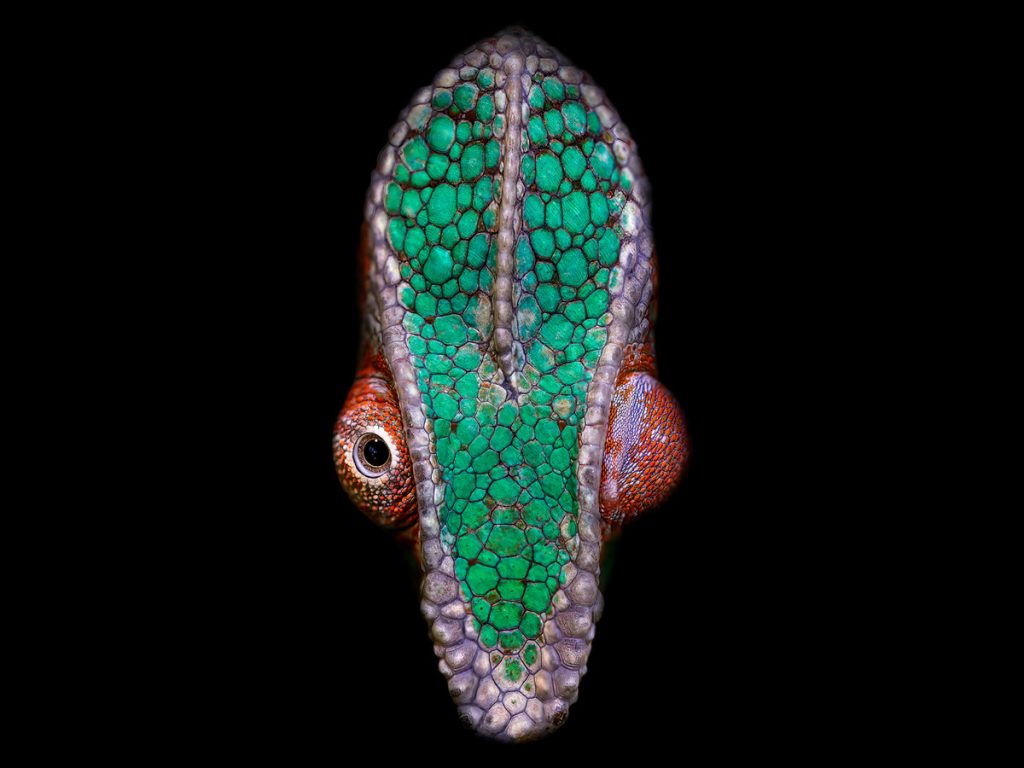
Each species perceives the world it needs to perceive in order to survive.
In the end, what may distinguish human consciousness from that of other animals is not its intensity, nor any superior value, but a specific additional capacity: the ability to reflect on one’s own experience, to turn it into an object of thought through language. Animals feel. We can also ask what it means to feel. That difference is real. But it does not make animal consciousness inferior. It simply makes it different. That consciousness, without the extra layer of reflection, is not incomplete. It is prior to language, and perhaps for that very reason, more immediate.
The Gorilla Infant
I have worked for many years with institutions that are part of the European program for protected species. My work requires maximum proximity to animals. Most of my portraits are made in conservation centers, rescue centers, and natural reserves, always under strict ethical conditions and without disturbing the animals. One of these collaborations is with the Madrid Zoo, and its result has been permanently exhibited in the Madrid Metro since 2022.
A few years ago, I went to photograph a newborn western lowland gorilla infant. When I arrived, I found the mother with her baby, only a few weeks old. I began photographing them, but after a few minutes the mother grew tired of my presence. She turned her back on me, holding the infant against her body. This often happens with primates: when they become bored with being observed, they simply remove visual contact. I assumed the session was over.
But a few seconds later, something happened. The infant’s head appeared from the side of its mother, peeking out just enough to see what was there. It looked directly at me and held my gaze for a moment without looking away. The mother still had her back to me. The infant did not. What impressed me was not simply that it looked at me, but the quality of that attention. It did not seem accidental, nor like a reflex. It seemed directed. As if something, even if only for an instant, had turned toward me with intention.
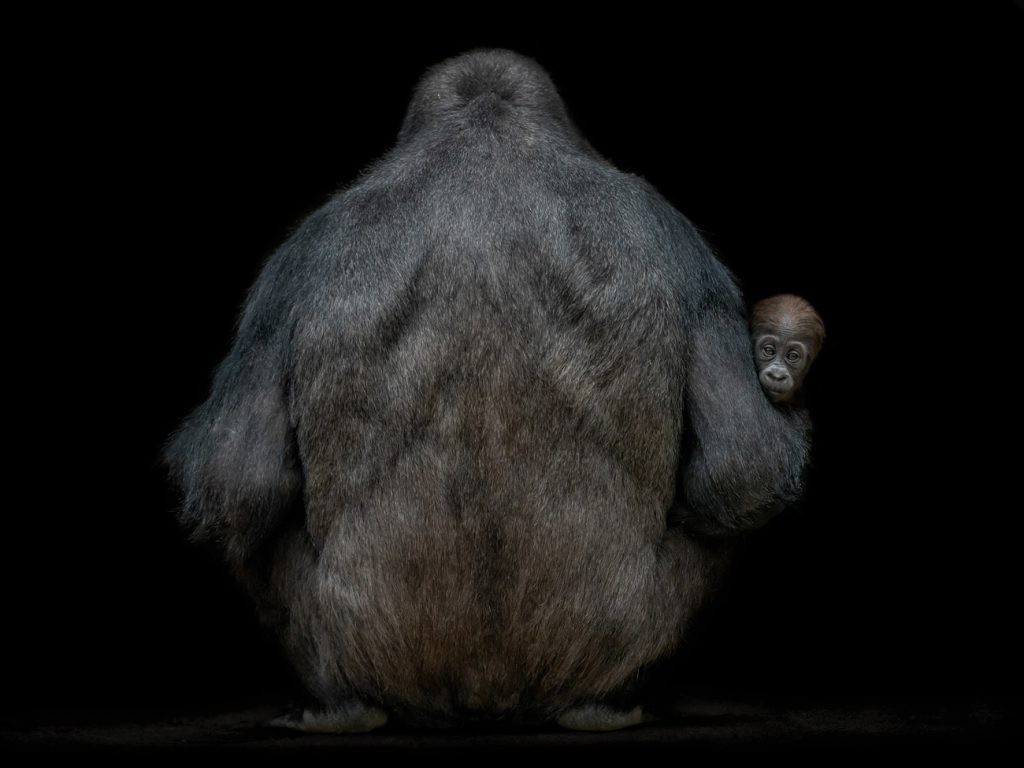
I cannot say what was there. I find it hard to believe it was only a reflex. Perhaps we will never be able to know for certain, but every time I look at the portrait I was able to make, I see in that gaze a form of presence that, for me, has to do with consciousness.
The Crocodile’s Heartbeat
Not all encounters feel the same. There is a Nile crocodile conservation center in Málaga, in southern Spain, where I once spent a day photographing. Crocodiles are among the most enigmatic animals I work with. When they are still, and they can remain motionless for hours, they seem almost like objects. Something closer to a stone than to a living being. And yet, even then, something is present. It is a different presence from that of a gorilla or a chimpanzee, and much harder to place.
At the end of the session, the keeper allowed me to hold a young crocodile, about forty centimeters long. I took it carefully in both hands, making sure it would not bite me. What I felt was unexpected: its breathing, slow and regular, and beneath it, its heartbeat. Its eye held a gaze I did not know how to interpret, but it was undeniably alive.
Standing there with that animal in my hands, I found myself asking the same old question, but this time it felt stranger, more unsettling.
The question does not become easier with evolutionary distance. But it does become more disturbing. With a gorilla, I can find a certain recognition, something familiar in the gesture or the gaze. With a crocodile, that disappears. And that absence does not make the question less important. On the contrary, it makes it larger. The difficulty I feel in imagining the inner life of a crocodile does not prove that there is nothing there. Rather, it is evidence that that inner life lies farther away than I can reach.
Presence, Not Intelligence
That doubt becomes sharper when I think about artificial intelligence.
Contemporary systems can recognize images, generate language, and perform tasks that once seemed to require understanding. They can hold conversations, solve problems, and produce texts that seem reflective. And yet, when I converse with a chatbot, something is missing that I cannot define precisely. The simulation of a personality feels artificial in a way my geese do not.
And the difference, I think, is not intelligence. It is presence.
When I look at a goose, I see its eyes, I feel a living closeness, something near to me despite the enormous differences that separate us. That does not happen with any language model, however sophisticated it may be. And the distinction matters, because it suggests that what responds to us in animals is not their cognitive capacity. It is something more basic: the sense that there is something it feels like to be them. That they have, in the most fundamental sense, an interior.
A 2025 study by Kristin Andrews, Jonathan Birch, and Jeff Sebo, published in Science, makes this observation: sophisticated linguistic behavior is not reliable evidence of subjective experience. An artificial system can behave as if it understands without there being anything that it “feels” like to be that system. The behavior is there. What is missing is something that cannot be imitated: that there is someone inside experiencing it.
If a system that surpasses humans in cognitive tasks has no inner life, then consciousness cannot be reduced to intelligence. It may be something closer to what even the simplest animals have always had: a body that registers the world, an interior that registers the difference between comfort and discomfort, hunger and satiety. Something that belongs, in the most basic sense, to being alive.
Even the simplest animal may be much closer to us than the most sophisticated machine. And clearly not because of its intelligence, which we may well underestimate, but because there is someone in there. Of machines, we cannot say the same.
Two Ways of Being Wrong
When we think about animal consciousness, two common errors arise. The first is anthropomorphism, that is, projecting our own emotions onto animals that experience the world in ways completely different from ours. The second could be called anthropodenial, that is, denying animals an inner life simply because we cannot prove it with certainty, treating the absence of proof as proof of absence.
I believe both errors are born of the same discomfort: we find it difficult to remain in doubt. And the attempt to answer the question too quickly creates a new problem.
In 2012, the Cambridge Declaration on Consciousness stated that animals possess the neurological elements necessary to manifest conscious states. In 2024, more than five hundred researchers signed the New York Declaration on Animal Consciousness, which proposed something modest but honest: that the evidence is sufficient for us to take the question seriously, and that we can no longer assume animals lack consciousness simply because they cannot describe it or express it in terms we recognize.
What is interesting about these two declarations is not that they solve the question, because they do not. What is interesting is that the burden of proof has now shifted from them to us. For most of Western history, animals were expected to prove their inner life in a way that would be obvious to human observers. Now that framework has changed. We no longer wait for animals to demonstrate their inner life. Now we are the ones responsible for examining the reasons that have led us to deny it to them.
What Follows
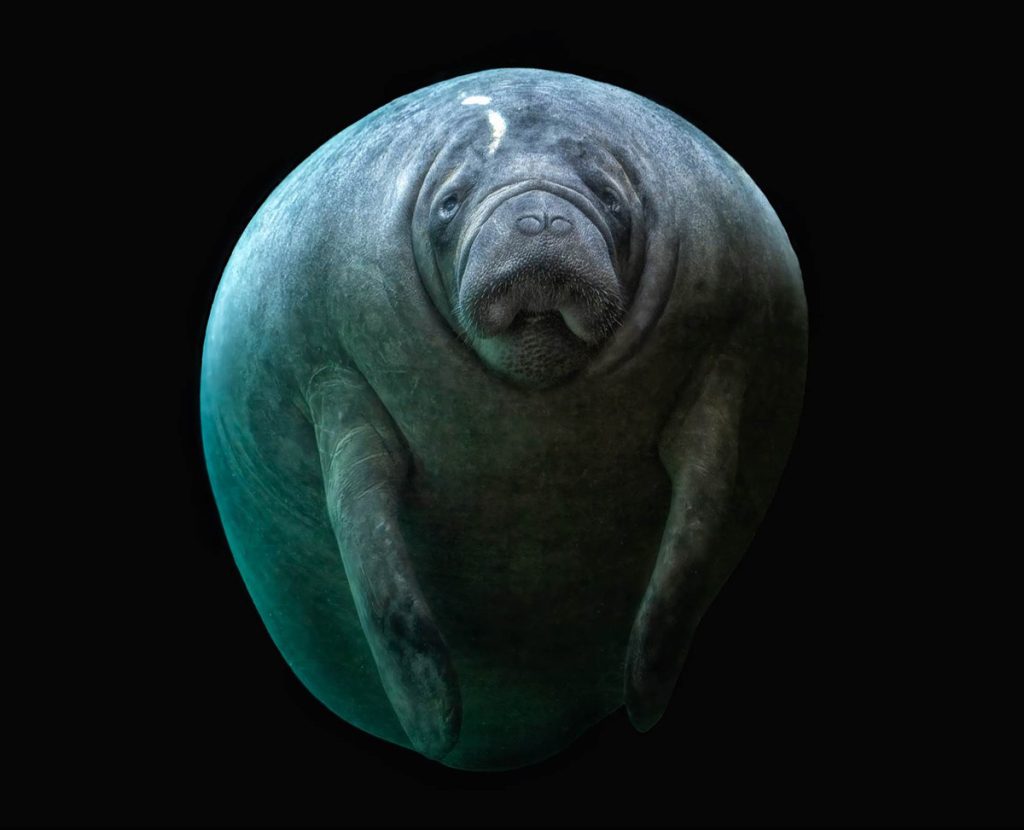
But the difficulty does not lie only in the fact that we do not truly know what animals experience. It also lies in the fact that this ignorance does not free us from responsibility.
If animals have forms of experience, even if they are radically different from ours, the ethical consequences are hard to avoid. Peter Singer formulated it simply: what matters morally would not be intelligence, but the capacity to suffer. It is a convincing framework, but it raises questions we do not know how to answer: how do we compare suffering across very different nervous systems? What responsibility do we have toward beings whose experience we cannot fully understand, or perhaps cannot understand at all?
If we cannot even compare visual capacities, to name just one example, how could we compare the capacity to suffer?
The temptation would be to resolve this dilemma too quickly: on one hand, by extending the same moral consideration to every form of sentient life; on the other, by denying it, using ignorance as an excuse for inaction. Neither answer is satisfactory. The first risks flattening real differences. The second risks becoming a convenient pretext.
What remains, then, is something more complicated: deciding without certainty. What we do with animals is never entirely neutral, especially when it involves harming them. It reflects assumptions about what matters and what does not. Realizing this, even imperfectly, is already a step away from indifference.
There is another layer of complication. Life is only possible by consuming other life. There is no neutral position within that system. The question, then, is how to act without denying what is at stake.
What Remains
In the presence of an animal, it is almost impossible to deny that the gaze is not empty, yet it remains a mystery. Photography, in this context, becomes more than documentation. Each portrait is an attempt to keep the question open rather than resolve it. I have photographed hundreds of species. I have never had the impression that I was photographing a machine.
We may never know what it feels like to be a lion, or a bat, or a bee flying through a landscape it perceives through ultraviolet light, a landscape we cannot see. That limit is real. But there is a difference between not knowing everything and knowing nothing. Scientific evidence, whether behavioral, neurological, evolutionary, or even philosophical, points in one direction: something feels in the bodies of animals. In their way, not in ours. Each species inhabits its own Umwelt, its own world. And perhaps also its own way of being present. I have built my work on this recognition. It is what I keep returning to, every morning, when the geese come running each time I put on my hat and go out to give them their grain.